Oil Refinery Upgrade in Pakistan: How Euro V Fuel Could Transform the Petroleum Sector?
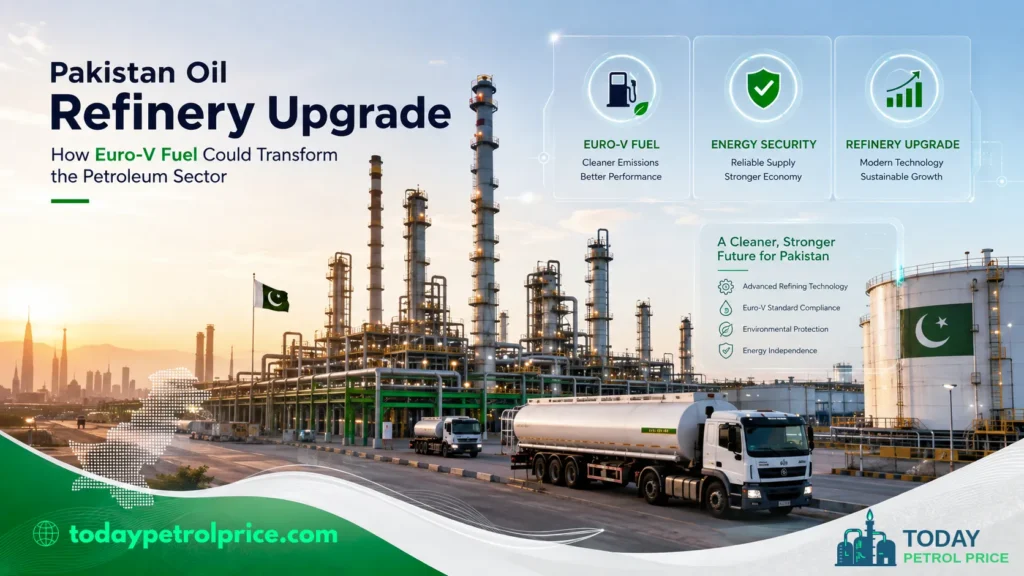
Pakistan’s petroleum sector is entering an important transition period. The discussion is no longer limited to changes in petrol prices. Refinery modernization, fuel quality, energy security, imported fuel dependence, strategic petroleum reserves, and cleaner fuels are becoming equally important.
The oil refinery upgrade in Pakistan has gained renewed attention after the government approved amendments to the country’s Brownfield Refining Policy in July 2026. The policy is designed to modernize existing refineries and encourage investment in better refining technology. It also aims to increase the production of higher-quality petroleum products while reducing dependence on imported fuels.
The government has linked refinery modernization with energy security. It has also emphasized the production of Euro-V compliant petrol and diesel. These changes could influence consumers, vehicle owners, transport businesses, industries, and the wider Pakistani economy.
For readers who regularly follow today petrol price updates, this development is important because the petroleum market involves much more than the retail price displayed at a fuel station.
What Is the Oil Refinery Upgrade in Pakistan?
The oil refinery upgrade in Pakistan refers to planned modernization of existing petroleum refineries. These projects are intended to improve refining efficiency, increase the production of valuable fuels, improve fuel quality, and reduce the production of lower-value petroleum products.
Pakistan has historically depended on a combination of local refining and imported petroleum products. Modernizing domestic refineries could help change that balance.
According to government statements, refinery upgrades are expected to support cleaner Euro V fuel production and reduce dependence on imported petroleum products. The government has also described refinery modernization as an important part of national energy security. (PID)
The revised refining policy is therefore more than an industrial investment plan. It could influence Pakistan’s fuel supply chain for years.
Why Is Refinery Modernization Important for Pakistan?
Pakistan consumes large quantities of petroleum products for transportation, agriculture, industry, logistics, and electricity-related activities.
When local production does not fully satisfy demand, the country needs imports. Imported petroleum products require foreign currency and depend on international shipping, global crude markets, freight costs, and regional stability.
The recent regional disruptions have demonstrated why energy supply chains can become vulnerable.
Reuters reported in August 2026 that Pakistan’s largest refiner, Cnergyico, was increasing U.S. crude imports following disruptions affecting Gulf oil shipments. The situation highlighted Pakistan’s reliance on routes through the Strait of Hormuz. (Reuters)
This makes the oil refinery upgrade in Pakistan strategically important.
A stronger domestic refining system cannot eliminate imports completely. However, it can provide greater flexibility and improve Pakistan’s ability to manage supply disruptions.
Oil Refinery Upgrade in Pakistan and Energy Security
Energy security means having reliable access to energy at manageable cost and with sufficient supply resilience.
For Pakistan, petroleum security involves several areas:
| Energy security factor | Why it matters |
|---|---|
| Local refining | Reduces dependence on imported finished fuels |
| Strategic reserves | Provides protection during supply disruptions |
| Storage capacity | Helps maintain fuel availability |
| Diverse crude sources | Reduces dependence on one supply route |
| Modern refineries | Improves fuel output and efficiency |
| Better fuel standards | Supports cleaner and more efficient engines |
| Digital monitoring | Improves visibility across the supply chain |
The government has specifically directed authorities to enhance strategic petroleum reserves. It has also emphasized improving storage infrastructure as part of the broader refining strategy. (Radio Pakistan)
This is especially relevant when international shipping routes become uncertain.
What Is Euro V Fuel?
Euro V, commonly written as Euro 5, refers to a fuel-emission standard designed to support cleaner vehicle operation.
The standard is associated with tighter limits on certain fuel contaminants, especially sulfur, and is part of a broader effort to reduce harmful vehicle emissions.
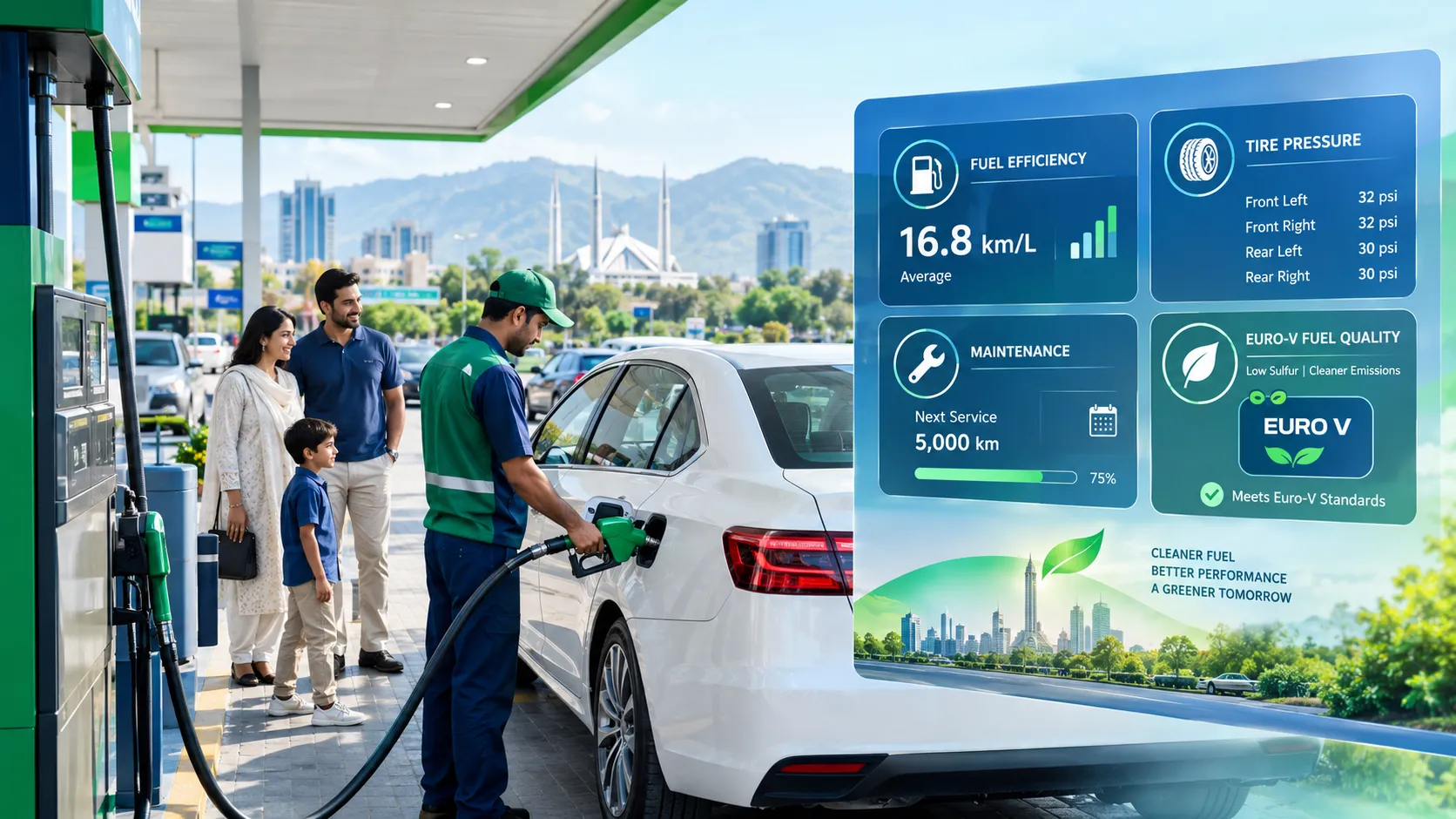
The important point for Pakistani consumers is that cleaner fuel can contribute to better environmental performance when it is used with compatible engines and properly maintained vehicles.
Pakistan’s government has stated that refinery modernization should support the production of Euro V compliant petrol and diesel.
The transition is therefore closely connected with the oil refinery upgrade in Pakistan.
Why Euro V Fuel in Pakistan Matters?
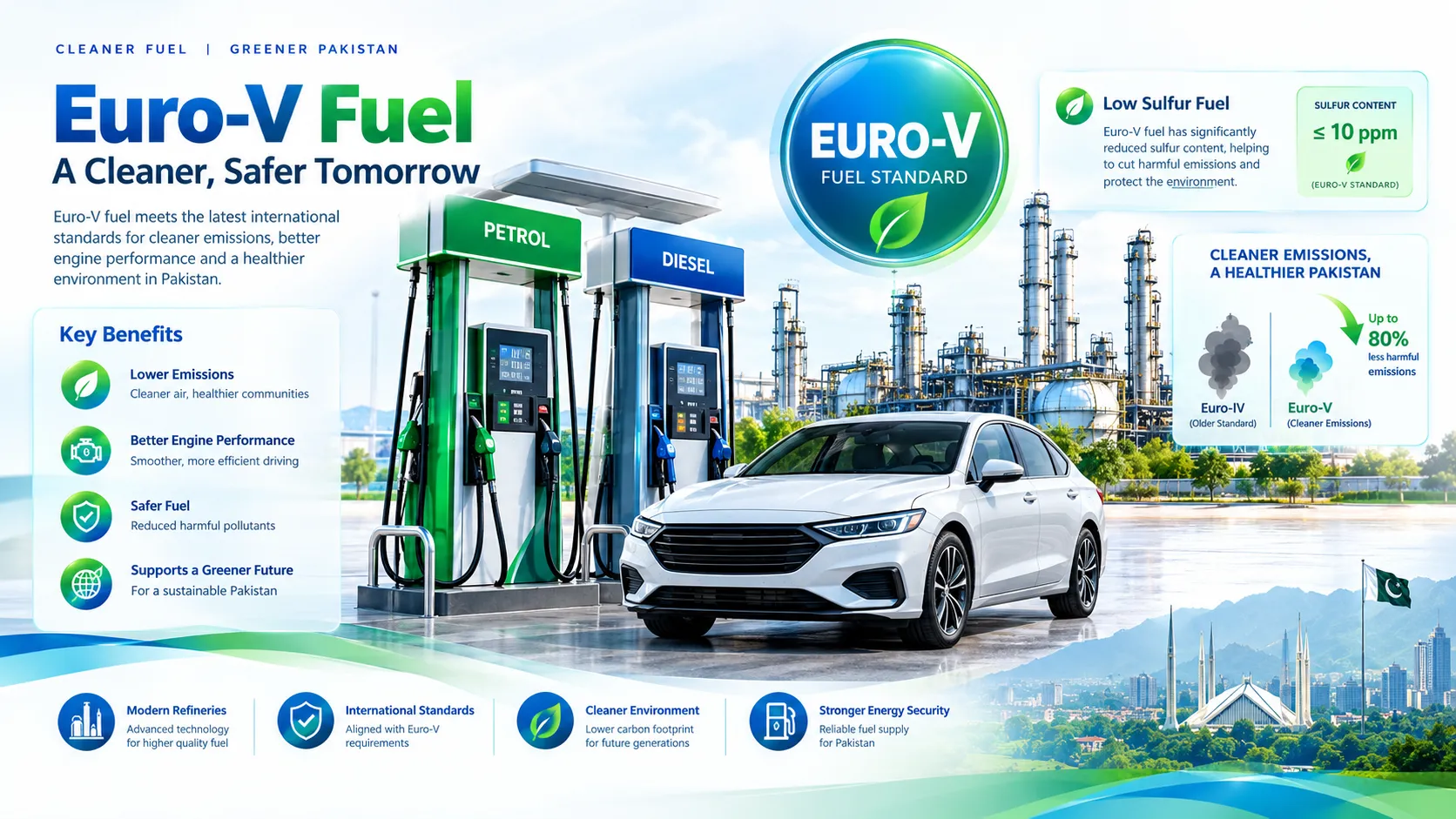
The discussion around Euro V fuel in Pakistan is becoming more important because transportation is a major source of urban air pollution.
Cleaner fuel standards can support several objectives:
- Lower sulfur content
- Reduced harmful emissions
- Better compatibility with modern emission-control systems
- Improved environmental performance
- Greater alignment with international fuel standards
- More efficient modern refining processes
However, fuel quality is only one part of the equation.
Vehicle age, engine condition, maintenance, traffic congestion, driving behavior, lubricant quality, and emission-control technology also influence actual emissions.
Therefore, Euro V fuel in Pakistan should be viewed as one component of a wider clean-transport strategy.
How Refinery Upgrades Could Affect Petrol and Diesel Supply
One of the biggest potential benefits of the oil refinery upgrade in Pakistan is increased domestic production of useful petroleum products.
Pakistan’s revised policy is designed to shift refinery output toward higher-value products while reducing the production of furnace oil and other lower-value products.
Reporting on the revised policy says five existing refineries are expected to modernize their facilities. It also estimates that refinery upgrades could substantially increase petrol and high-speed diesel production while reducing furnace oil output.
This could gradually improve the country’s petroleum supply structure.
The effect will not necessarily be immediate. Refinery modernization requires engineering work, equipment installation, financing, testing, and commissioning.
Therefore, consumers should distinguish between announced refinery investment and actual additional fuel production.
Oil Refinery Upgrade in Pakistan: Expected Benefits
The planned modernization could create several long-term benefits.
1. Greater Domestic Fuel Production
Modern refineries can extract more valuable products from crude oil.Higher domestic production could reduce the volume of finished petroleum products that Pakistan needs to import.
2. Better Fuel Quality
Modern refining technology can support the production of cleaner fuels. This is particularly important as Pakistan moves toward Euro V fuel standards.
3. Lower Import Dependence
Pakistan will likely continue importing crude oil and some petroleum products. However, stronger domestic refining capacity could reduce dependence on imported finished fuels.
4. Improved Energy Security
Modern refineries can provide additional flexibility during international supply disruptions. This is especially valuable when shipping routes or global energy markets become unstable.
5. Reduced Furnace Oil Production
The revised policy aims to reduce production of furnace oil and increase the production of more useful transportation fuels.
6. Potential Investment and Employment
Large refinery projects require engineering, construction, logistics, maintenance, technology, and skilled labor. This can generate economic activity throughout the petroleum supply chain.
Oil Refinery Upgrade in Pakistan vs. Imported Fuel
Pakistan’s petroleum system can broadly be understood through three stages:
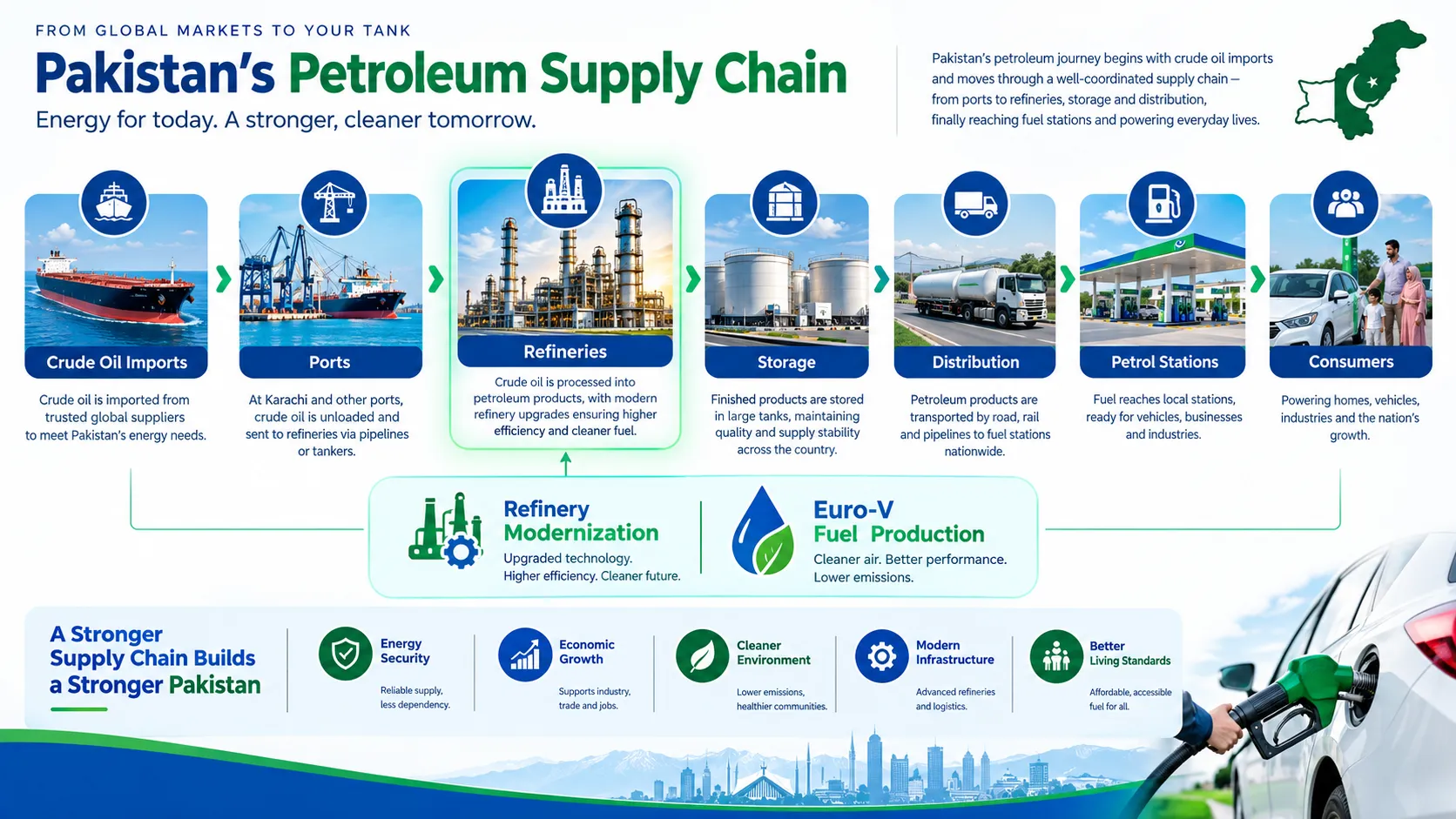
Crude oil imports → Local refining → Petroleum products
Another route is:
Finished fuel imports → Storage → Distribution → Retail stations
Modernizing domestic refineries could increase the first route.
Simplified comparison
| Factor | Imported finished fuel | Modern domestic refining |
|---|---|---|
| Foreign exchange requirement | High | Still required for crude |
| Supply-chain exposure | Higher | Potentially lower |
| Local value addition | Lower | Higher |
| Refining jobs | Limited locally | More opportunities |
| Fuel quality control | Import testing required | Domestic refinery testing |
| Energy security | More exposed to shipping | Greater flexibility |
| Technology investment | Outside Pakistan | Domestic infrastructure |
This does not mean Pakistan can stop petroleum imports.The country will still need crude oil and potentially some refined products. The goal is greater flexibility rather than complete independence.
How Fuel Quality Is Monitored in Pakistan?
Fuel quality is an important part of Pakistan’s petroleum system.
The Hydrocarbon Development Institute of Pakistan (HDIP), provides testing and evaluation services for several petroleum products. These include gasoline, high-speed diesel, kerosene, furnace oil, lubricating oil, and other petroleum-related products.
OGRA also has responsibilities relating to petroleum-product standards and quality monitoring.
Its published material describes quality testing across different stages, including imports, refineries, oil depots, lubricant plants, retail outlets, and pipeline terminals.
Punjab has also issued orders relating to fuel-quality testing at retail outlets for gasoline and high-speed diesel. (EPD Punjab)
This shows that fuel quality is not determined only at the petrol pump.Testing can occur throughout the supply chain.
Why Fuel Quality Matters to Pakistani Drivers?
For ordinary drivers, fuel quality can affect the ownership experience.
Poor-quality or contaminated fuel may contribute to problems such as:
- Reduced engine performance
- Fuel-system deposits
- Poor acceleration
- Increased maintenance requirements
- Unusual engine behavior
- Potential damage to sensitive fuel components
Drivers should therefore avoid purchasing fuel from questionable sources. Consumers should also keep receipts where possible and report suspected fuel-quality problems through appropriate regulatory or company channels.
Oil Refinery Upgrade in Pakistan and Vehicle Owners
The connection between refinery modernization and vehicle owners may seem indirect.
However, it can become important over the long term. Modern vehicles increasingly rely on sophisticated emission-control systems and fuel-management technology. Cleaner fuel can support the operation of these systems.
At the same time, older vehicles may not receive the same benefits as modern vehicles. This is why Euro V fuel in Pakistan should not be presented as a guarantee of better fuel economy for every vehicle.
Actual mileage depends on many factors.
These include:
- Engine size
- Vehicle weight
- Tire pressure
- Traffic conditions
- Driving style
- Engine maintenance
- Air-conditioning use
- Fuel quality
- Lubricant quality
Fuel Economy: What Drivers Can Do?
While refinery upgrades are long-term projects, drivers can improve fuel efficiency immediately.
Maintain correct tire pressure
Underinflated tires increase rolling resistance.
Avoid aggressive acceleration
Sudden acceleration generally increases fuel consumption.
Keep the engine maintained
Dirty filters, worn spark plugs, poor lubrication, and other maintenance problems can reduce efficiency.
Reduce unnecessary weight
Carrying unnecessary heavy items can increase fuel consumption.
Avoid excessive idling
Leaving an engine running while parked wastes fuel.
Use the correct engine oil
The vehicle manufacturer’s recommended lubricant specification should be followed.
Plan routes
Repeated short trips and heavy traffic can increase fuel consumption.
The Digital Side of Pakistan’s Petroleum Sector
Another important development is digital monitoring.
In August 2026, Prime Minister Shehbaz Sharif directed reforms involving OGRA and called for a nationwide digital system to monitor fuel movement from ports and refineries to petrol stations. (Ministry of Interior Pakistan)
The objective is greater transparency and oversight across the petroleum supply chain.
A digital monitoring system could potentially help authorities understand:
Import → Port → Refinery → Storage → Distribution → Petrol Station
This could improve visibility and help identify irregularities.
It may also become increasingly important as Pakistan moves toward more sophisticated petroleum-market reforms.
What About Petroleum Smuggling?
Fuel smuggling has long been a concern because petroleum products can move across borders outside formal channels. Smuggling can affect legitimate businesses, government revenue, and fuel-market transparency.
Digital tracking can potentially improve supply-chain visibility. However, technology alone cannot eliminate smuggling. Effective enforcement, border controls, taxation policies, market pricing, and cooperation between agencies are also required.
For consumers, the practical lesson is simple:
Buy fuel from reputable, licensed retail outlets.
Oil Refinery Upgrade in Pakistan and the Economy
Petroleum is deeply connected to Pakistan’s economy.
Fuel is required by:
- Transport companies
- Farmers
- Manufacturers
- Logistics businesses
- Construction companies
- Airlines
- Power-related industries
- Retail businesses
- Private vehicle owners
When petroleum supply becomes unstable, transportation and logistics costs can rise. This can affect the prices of goods and services. A stronger refining system could therefore have benefits beyond the petroleum sector.
Simplified economic chain
Modern refineries → Higher-quality domestic fuel → Greater supply flexibility → Lower import dependence over time → Improved energy security → Potential economic stability
This is a long-term process rather than an immediate price-reduction mechanism.
Important: Refinery Upgrades Will Not Automatically Make Petrol Cheap
Consumers should keep expectations realistic.
Retail fuel prices are influenced by multiple variables.
These include:
- International crude prices
- Imported product prices
- Exchange rates
- Taxes and petroleum levies
- Freight costs
- Insurance
- Refinery costs
- Distribution margins
- Government pricing decisions
- Global supply conditions
Domestic refining can improve supply security and potentially reduce some import exposure.
But it cannot completely isolate Pakistan from global oil prices.
Current Petroleum-Sector Direction in 2026
Pakistan’s petroleum sector is moving toward several simultaneous changes.
| Development | Potential objective |
|---|---|
| Refinery modernization | Increase domestic refining capability |
| Euro-V production | Improve fuel quality |
| Strategic reserves | Strengthen supply security |
| Digital monitoring | Improve supply-chain transparency |
| OGRA reforms | Improve regulation |
| Storage expansion | Increase resilience |
| Import diversification | Reduce supply-route dependence |
| Lower furnace oil output | Increase higher-value fuel production |
The Ministry of Energy’s Petroleum Division continues to publish petroleum-product notifications and sector updates.
For readers tracking Pakistan’s petroleum market, these developments deserve attention alongside daily fuel rates.
What Could Change for Consumers?
The impact will probably occur gradually.
Short term
Consumers may notice limited direct changes because refinery projects take time.
Medium term
Refinery upgrades could begin improving domestic production capacity and fuel quality.
Long term
Pakistan could become more resilient against certain international supply disruptions.
The biggest potential benefit may therefore be stability rather than an immediate reduction in petrol prices.
What Should Pakistani Consumers Watch?
People following the petroleum sector should watch several indicators.
1. Refinery project progress
Announcements are important, but construction and commissioning are more meaningful.
2. Euro V fuel availability
The transition from policy to widespread commercial availability matters.
3. Strategic petroleum reserves
Higher storage capacity can strengthen supply resilience.
4. Import requirements
If domestic refining increases, the composition of petroleum imports could change.
5. OGRA reforms
Regulatory changes may influence competition and market transparency.
6. International shipping conditions
Pakistan remains connected to global petroleum supply chains.
7. Exchange-rate movements
The rupee remains important for imported crude and petroleum products.
How TodayPetrolPrice.com Can Help?
Following Pakistan’s petroleum sector requires more than checking one number.
On TodayPetrolPrice.com, readers can monitor fuel-related information and use the website as a convenient reference when researching Pakistan’s petroleum market.
For consumers, it is useful to combine fuel-price information with practical topics such as fuel economy, petroleum products, vehicle maintenance, fuel quality, and energy-sector developments.
You can also visit TodayPetrolPrice.com for the latest petroleum information and related resources.
Final Thoughts
For years, public attention has focused heavily on the latest petrol price. However, the country’s long-term petroleum future depends on much more than the price at the pump.
The oil refinery upgrade in Pakistan could become one of the sector’s most important developments in 2026 and beyond. Modernizing existing refineries could increase domestic production, improve fuel quality, reduce the production of lower-value petroleum products, and strengthen energy security.
The push toward Euro V fuel in Pakistan is equally important. Cleaner fuel standards can support modern vehicles and contribute to broader environmental goals. At the same time, Pakistan needs better storage, stronger supply-chain monitoring, reliable imports, effective regulation, and continued investment.
For consumers, the best approach is to look beyond daily fuel prices.
- Watch refinery modernization.
- Watch fuel quality.
- Watch strategic reserves.
- Watch petroleum imports.
The petroleum sector of tomorrow will not be defined only by the price displayed at a petrol station. It will also be defined by fuel quality, refining technology, supply security, infrastructure, regulation, and energy efficiency.
Frequently Asked Questions (FAQ’s)
What is the oil refinery upgrade in Pakistan?
Why is Pakistan upgrading its oil refineries?
What is Euro V fuel in Pakistan?
Will Euro V fuel improve car mileage?
Will refinery upgrades reduce petrol prices?
How much investment is expected in refinery upgrades?
Will Pakistan stop importing petroleum products?
Why are strategic petroleum reserves important?
Who monitors petroleum-product quality in Pakistan?
How can drivers save fuel?